Ελληνικά
 English
 Deutsch
 Italiano
 Français
 Español
 Nederlands
 Polski
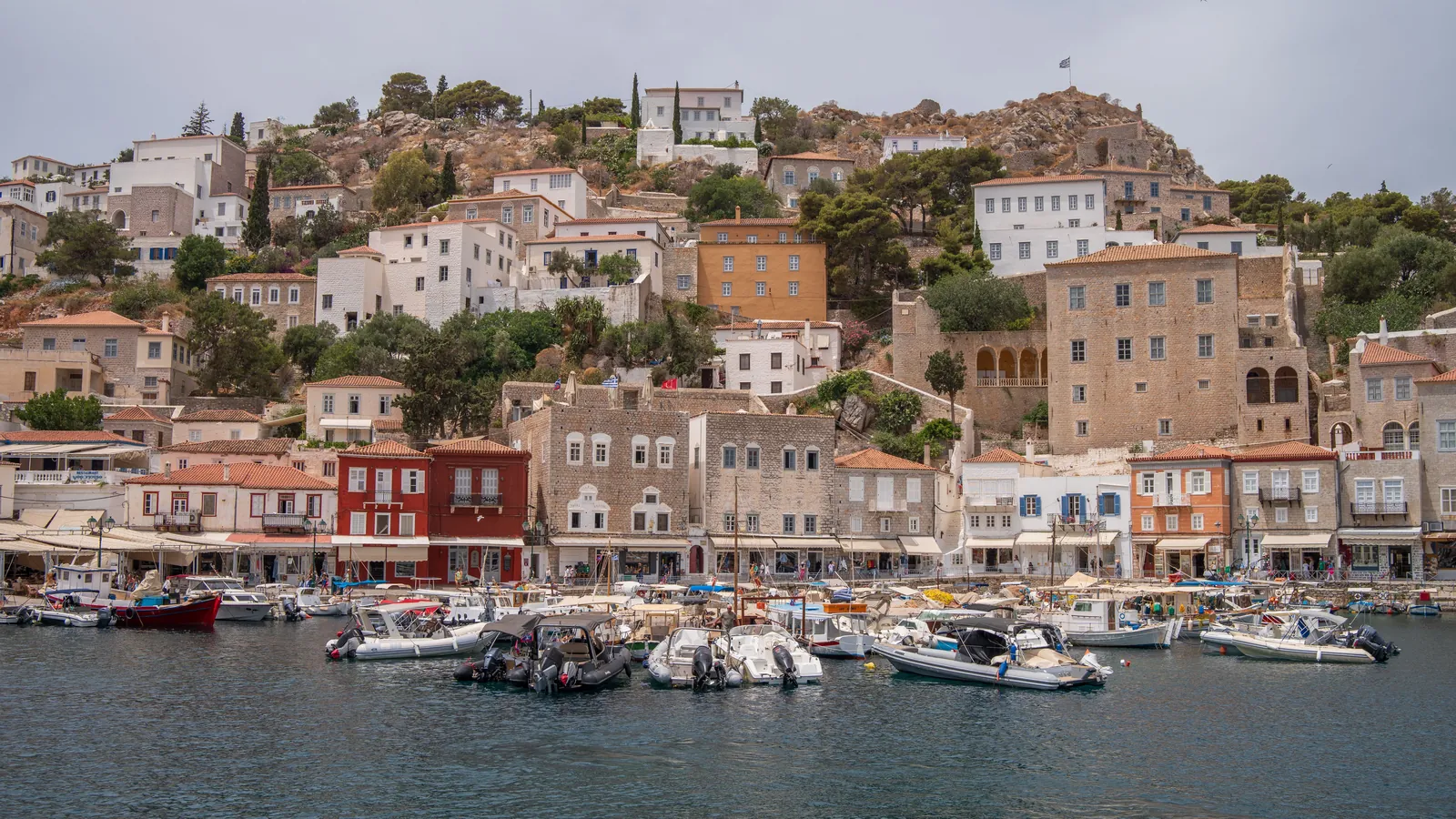
The Saronic Islands are the closest islands to Athens. Salamis almost touches Perama, Aegina and Agistri are a short distance from Piraeus, while Poros, Hydra and Spetses lie just off the eastern Peloponnese coast.
Below, you’ll find the ports, routes with approximate journey times, driving options and how to get around each island. We hand-pick every accommodation in our guide based on its merits.
By air: Athens Airport
None of the Saronic Islands has an airport. Visitors coming from further afield land at Athens International Airport “Eleftherios Venizelos”, which has year-round international flights. Aegean and SKY express fly to Athens from Thessaloniki, Crete and other airports across the country.
From the airport, take the X96 bus directly to the port of Piraeus, or Metro Line 3, which terminates in Piraeus beside the port. Allow about an hour, more in traffic, and leave enough time before your ferry departs.
By ferry from Piraeus
For all the islands except Salamis, ferries depart from Piraeus. Saronic ferries do not leave from Rafina or Lavrio and usually depart from Gate E8. There are two types of vessel, serving different routes.
Conventional ferries: Aegina, Agistri, Methana, Poros
Passenger and car ferries, such as those operated by Saronic Ferries, serve Aegina, Agistri, Methana and Poros. As a guide, the journey takes about 1 hour and 10 minutes to Aegina, around an hour and a half to Agistri, and a little over two and a half hours to Poros. They carry cars, which is useful if you want to explore Aegina or Poros.
Hydrofoils: Aegina, Agistri, Poros, Hydra, Spetses
Hydrofoils save time but do not carry vehicles. Aegean Flying Dolphins runs daily services to Aegina, taking about 45 minutes, and also calls at both ports on Agistri, Skala and Myloi.
The second route, served by Hellenic Seaways hydrofoils and other operators, connects Piraeus with Poros, Hydra and Spetses; some services also call at Ermioni or Porto Heli. Allow about an hour and a half to Hydra and around two hours to Spetses.
By road, via the Peloponnese
Poros, Hydra and Spetses are just a few minutes from the Peloponnese coast, so you can drive there and cross by boat. The route starts on Attiki Odos, continues along the Athens–Corinth National Road and then heads towards Epidaurus.
- Poros from Galatas: about 2 hours and 15 minutes from Athens. Boats make the crossing around the clock, while the car ferry runs about every half hour, from morning until evening.
- Hydra from Metochi: Metochi is on the opposite shore; leave your car there and cross by boat or water taxi. No vehicles are allowed on the island.
- Spetses from Kosta: about 3 hours from Athens, via Kranidi and Porto Heli. Private cars are not allowed to circulate freely on Spetses, so leave yours at Kosta and cross by boat or water taxi.
Without your own car, combining buses to Galatas or Kosta takes a long time, so the hydrofoil from Piraeus is the simplest option.
Salamis: a short crossing
Salamis is so close to the Attica coast that many people treat it like a suburb. Ferries from Perama reach Paloukia in about a quarter of an hour, while the crossing from the port of Megara to Faneromeni takes ten minutes.
Both routes carry cars and have frequent departures, so there’s no need to book. You can get to Perama from Piraeus by local bus or taxi.
Between the islands
Saronic ferry routes let you combine islands without returning to Piraeus, as long as the timetables line up:
- Aegina–Agistri: small ferries leave from the port of Aegina Town and reach Agistri in 15 to 20 minutes.
- Aegina–Poros: conventional ferries on the route continue from Aegina to Methana and Poros.
- Poros–Hydra–Spetses: hydrofoils from Piraeus call at the three islands in succession, making it easy to combine them.
Salamis has no regular connections to the other islands.
Getting around each island
The islands are small, but each has its own rules:
- Aegina: buses run from the port to Agia Marina, Perdika and Souvala; taxis and car and scooter rentals are available in town.
- Agistri: explore on foot, by bicycle or scooter; a local bus connects Skala with the other settlements.
- Poros: the local bus starts in town, with a timetable that varies by season. In summer, taxis run around the clock, and small boats take you to beaches.
- Hydra: no cars or motorbikes. Get around on foot, have your luggage carried by mules, or take water taxis to Vlychos, Mandraki and remote coves.
- Spetses: the ring road circles the island in about 25 kilometres and is easy to explore by bicycle or scooter. Horse-drawn carriages wait at Dapia and Poseidonion, and water taxis from Dapia go to the beaches.
- Salamis: settlements are spread out, so a car is useful.
When to travel and practical tips
May, June and September bring mild weather and fewer visitors. In July and August, especially at weekends, the islands get busy, including with Athenians visiting for a few days.
- Book early: from June to September, weekend hydrofoils fill up quickly. The same applies at Easter, around 15 August, during Hydra’s Miaoulia celebrations in late June, and at Spetses’ Armata festival in September.
- Wind: the Saronic Gulf is more sheltered than the open Aegean, but strong winds can cancel hydrofoils first, while conventional ferries usually keep sailing. Check the schedules the day before.
- In winter: Aegina and Salamis have year-round connections, while services to Hydra and Spetses become less frequent and many accommodations close.
- Car or no car?: A car is useful on Aegina, Poros and Salamis, but stays on the mainland if you’re visiting Hydra or Spetses.
Now that you know how to get there, choose a base with our guide to where to stay in the Saronic Islands. For each island, see where to stay in Aegina, where to stay in Agistri, where to stay in Hydra and where to stay in Poros.
Frequently asked questions
Quick answers to the questions people most often ask when planning their trip.
Which Saronic island is closest to Athens?
Salamis. Ferries from Perama reach Paloukia in about a quarter of an hour, while the crossing from the port of Megara to Faneromeni takes ten minutes. They carry cars and run frequently, so there’s no need to book. Of the islands popular with tourists, Aegina is the closest: the hydrofoil from Piraeus takes about 45 minutes, while the conventional ferry takes about 1 hour and 10 minutes.
Which port do ferries to Hydra and Spetses leave from?
They leave from Piraeus, usually from Gate E8. Hydrofoils operated by Hellenic Seaways and other companies call at Poros, Hydra and Spetses; some services also stop at Ermioni or Porto Heli. Allow about an hour and a half to Hydra and around two hours to Spetses. From Athens Airport, you can reach Piraeus by X96 bus or Metro Line 3.
Can you take your car to Hydra or Spetses?
No. No vehicles are allowed on Hydra, and private cars are not allowed to circulate freely on Spetses. If you’re driving, leave your car on the opposite Peloponnese shore, at Metochi for Hydra or Kosta for Spetses, and cross by boat or water taxi. On Spetses, get around by scooter, bicycle, horse-drawn carriage or water taxi; on Hydra, walk.
How do you get from Aegina to Agistri?
Small ferries leave from the port of Aegina Town and reach Agistri in 15 to 20 minutes. Agistri has two ports, Skala and Myloi, which are also served by hydrofoils from Piraeus via Aegina. Conventional ferries also run from Piraeus, with a journey of around an hour and a half. On the island, get around on foot, by bicycle or scooter, or on the local bus.
How do you get to Poros by road?
Drive from Athens via Attiki Odos, the Athens–Corinth National Road and the road towards Epidaurus to Galatas; the journey takes about 2 hours and 15 minutes. From there, boats cross around the clock, and the car ferry runs about every half hour, from morning until evening. The crossing takes just a few minutes, so you can bring your car.