Ελληνικά
 English
 Deutsch
 Italiano
 Français
 Español
 Nederlands
 Polski
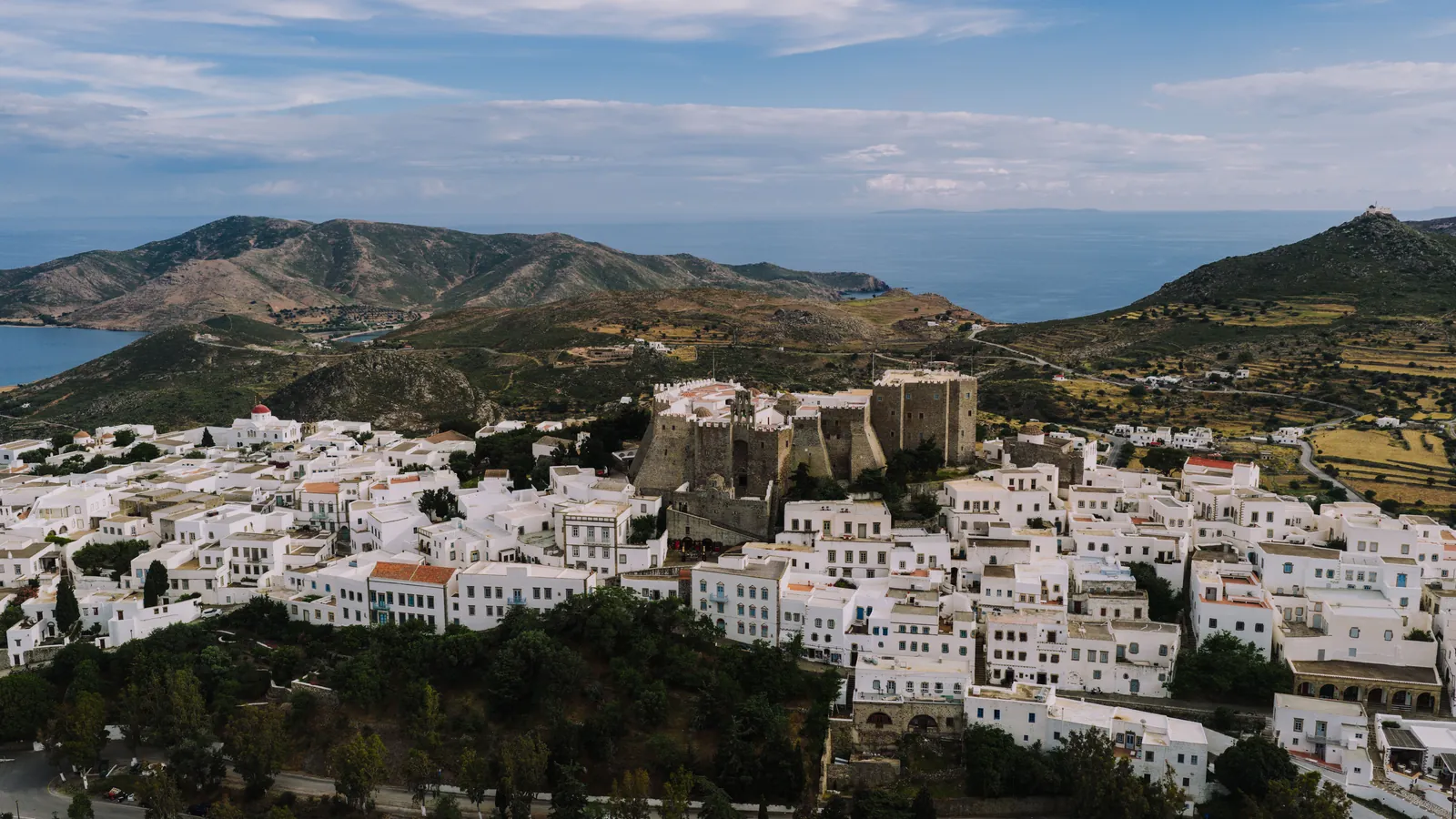
On Patmos, according to tradition, John wrote the Book of Revelation, and the monastery built in his name still dominates the island from the top of Chora. The Historic Centre of Chora, together with the monastery and the Cave of the Apocalypse, has been a UNESCO World Heritage Site since 1999.
For most people, the question of where to stay in Patmos has a simple answer, but each area offers something different. Below, you’ll find the island’s main bases and the accommodation we’ve hand-picked based on its features; see the accommodation in Patmos page for the full list.
How to choose an area
Distances are short, but each bay has its own character:
- Skala: the port and commercial centre, with tavernas, shops and vehicle rentals.
- Chora: the medieval settlement around the monastery, with a few atmospheric places to stay and panoramic views.
- Grikos and Sapsila: quiet bays southeast of Skala, with shallow waters and a small selection of accommodation.
- Kampos and northern Patmos: rural scenery and sandy beaches, best suited to those with a vehicle.
For a short stay or if you’re travelling without a car, Skala is the best choice. For a week of swimming and peace and quiet, Grikos and Sapsila are worth the short trip to the port.
In Skala, by the port
Skala stretches along the island’s most sheltered bay, where Patmos narrows. From here, boats leave for the southern beaches, and the path to Chora begins.
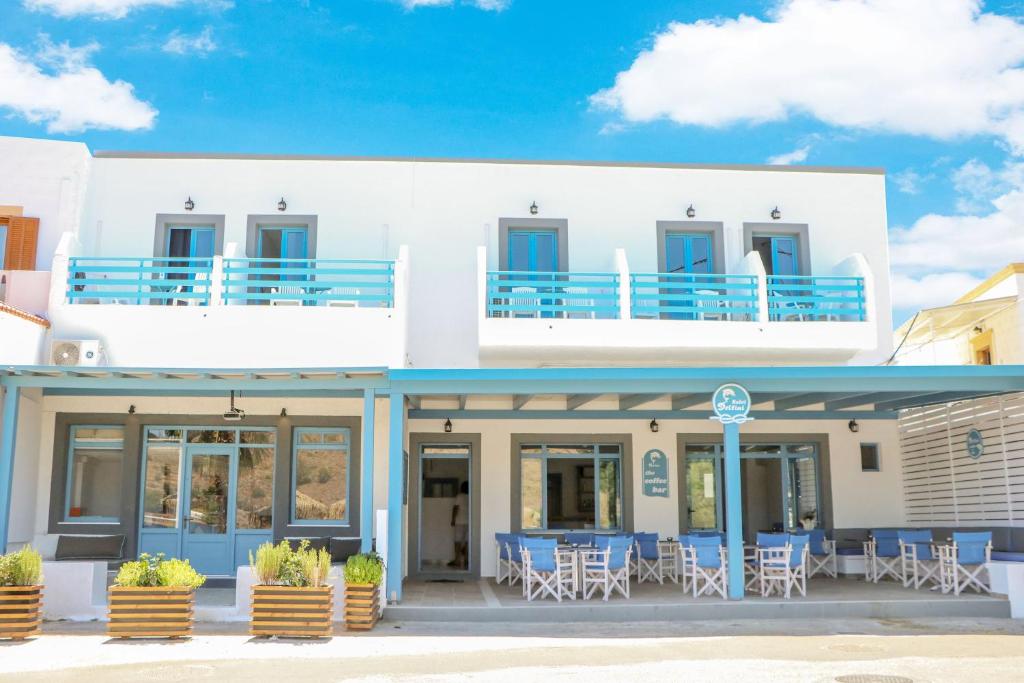
Ξενοδοχείο Δελφίνι
A two-star hotel on Skala’s seafront, with rooms that have a balcony or terrace and, in some double rooms, views of the water. It’s a good fit for couples, while the triple room works well for a small family. A minimum stay of three nights is required, payment is accepted in cash only, and there is no parking.
Patmos: self-catering apartments from Skala to Sapsila
If you’d like to cook for yourself, these two places offer the independence of a small home. The first is in the Skala area, while the second is in the quiet bay of Sapsila; find more options on the Patmos page.
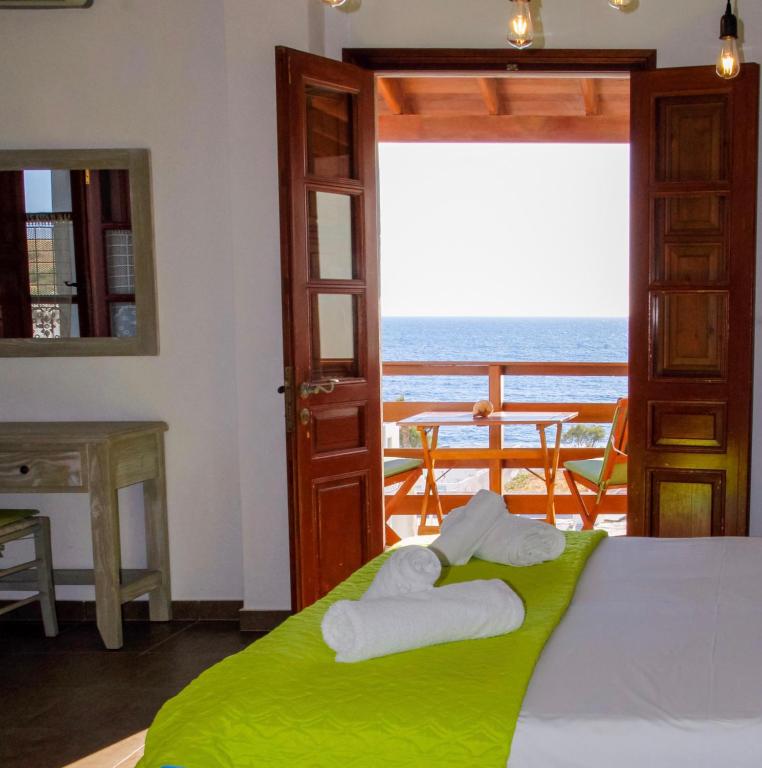
Mistral-Patmos
A convenient option if you want to cook: the air-conditioned units have a kitchen or kitchenette with a fridge and stovetop, and many have sea views from a balcony or terrace. The family room accommodates up to four people, and Wi-Fi is free throughout. There is no parking, and the upper floors are accessible by stairs only.
PATMOS Mathios Studios- apartments
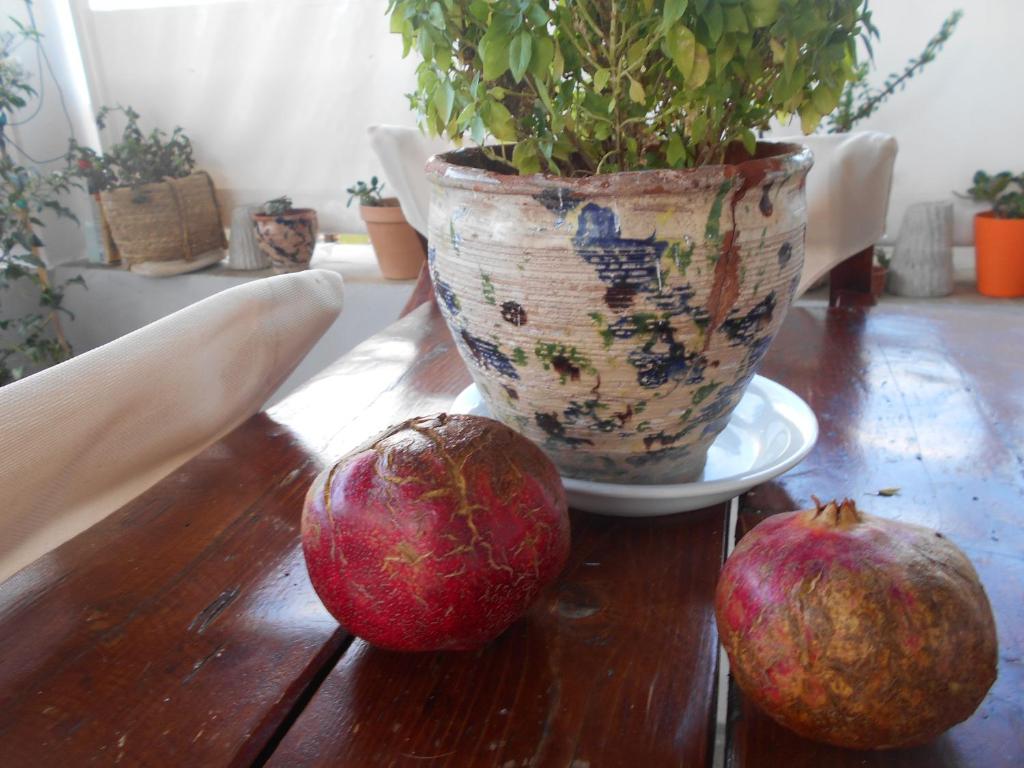
Studios and apartments in Sapsila, with a kitchenette equipped with a stovetop and fridge, and a balcony overlooking the garden, mountains or sea. The bay’s small beach is just a few steps away, and private parking is free with a reservation. Check-in is only available between 14:00 and 15:00, so arrange your arrival time in advance.
In Grikos
Grikos is an open bay with shallow waters, a few kilometres from Skala. The rock of Kalikatsou rises at its southern end, and evenings are much quieter than at the port.

HOTEL ATHINA
A two-star hotel a few metres from Grikos beach, with single and double rooms featuring balconies and views of the sea or mountains. It’s one of the few options with free private parking, although spaces cannot be reserved. Wi-Fi is available only in the rooms, and guests must arrive by 23:00.
What to see in Patmos
The Monastery of Saint John the Theologian was founded in 1088 by Saint Christodoulos and resembles a castle above Chora. Its treasury holds icons, manuscripts and religious artefacts; modest clothing is required for entry.
Halfway along the route from Skala to Chora is the Cave of the Apocalypse, a small cave lit by candles. Chora is worth an unhurried afternoon among mansions dating from the 16th to the 19th centuries; the Nikolaidis Mansion is now a museum.
The Apothianos Road, the old path connecting Skala with Chora, is the most beautiful way to make the climb. Other walking routes include the Kathismata, the monks’ austere caves, and Profitis Ilias, the island’s highest point.
Beaches
- Psili Ammos: a sandy beach in the south of the island, reached by boat or along a path.
- Lambi: at the northern tip, known for its colourful pebbles.
- Kampos and Agriolivadi: bays with shallow waters, convenient for families.
- Petra: beside the rock of Kalikatsou, with clear blue waters.
When to visit Patmos
June and September are the best-balanced months, with warm seas and fewer visitors. The island gets busy in July and August, and the meltemi winds often blow strongly.
Easter holds a special place: on Holy Thursday, the Washing of the Feet service is held in Chora, a ceremony that takes place only here and in Jerusalem. Each year in early September, at the start of the ecclesiastical year, the Religious Music Festival takes place, preceded by a chamber music festival in late August. Book accommodation well in advance for these periods.
How to get there and get around
Patmos has no airport. The ferry from Piraeus takes 7 to 12 hours, depending on the intermediate stops. The nearest airport is on Leros, with flights from Athens; from there, continue by ferry.
High-speed ferries connect Patmos with Leros, Lipsi, Kalymnos, Kos and Rhodes, as well as Samos, with schedules that vary by season. On the island, a local bus runs from Skala to Chora, Grikos and Kampos; taxis and car and motorbike rentals are also available. For other bases in the area, see our page on the Dodecanese.
Patmos is part of our guide to where to stay in the Dodecanese. To plan your route, see how to get to the Dodecanese, and if you’d like to combine your trip with a larger island, read where to stay in Kos or where to stay in Rhodes.
Frequently asked questions
Quick answers to common questions about planning a stay in Patmos.
What is the best area to stay in Patmos?
For most travellers, Skala is the best base: ferries dock there, it has the greatest choice of accommodation and restaurants, and buses to Chora and boats to the beaches leave from there. Those looking for peace and quiet by the water may prefer Grikos or Sapsila, a few kilometres to the south. Chora suits those seeking atmosphere and views, though accommodation options are more limited.
How do you get to Patmos?
The island has no airport, so the only way to get there is by ferry. The journey from Piraeus takes 7 to 12 hours, depending on the route. A faster option is to fly from Athens to Leros and continue by ferry. High-speed ferries also connect Patmos with Kos, Rhodes, Kalymnos and Samos, with schedules that vary by season.
Do you need a car in Patmos?
Not necessarily. If you stay in Skala, you can get around mostly on foot, take the local bus up to Chora and on to Grikos and Kampos, or catch boats to the southern beaches. A scooter or small car is useful if you want to explore the northern bays. Bear in mind that several places to stay in Skala do not have parking.
When is the best time to visit Patmos?
June and September combine warm seas with fewer visitors. The island is busy in July and August, and the meltemi winds often blow strongly. Easter is a special experience, with the Washing of the Feet service held in Chora on Holy Thursday, while the Religious Music Festival takes place each year in early September. Book accommodation well in advance for these periods.
What should you know before visiting the monastery and the Cave of the Apocalypse?
Both sites are active places of worship, so modest clothing is required, with shoulders and knees covered. The Cave is halfway along the route from Skala to Chora, and the monastery is at the top of the hill, so you can visit both on the same uphill walk, via the Apothianos Road, or by bus. Visiting in the morning, before the heat sets in, is more comfortable.